



|
|
|
|
||||||||


MICROLIGHT / MICROLIGHTING
£118
Discover the magnificent Belleville, Encombres, Meribel and Courchevel valleys in a two-seater motorbike of the sky by Capturing the spirit of the early pioneers of aviation.
Started in the late 1970s the sport of Microlighting developed through the introduction of power units for hang gliders. With the Microlights of this time it was an achievement to fly such aircraft just a few miles. Today, the average microlight bears little in common with its ancestors with Microlights able to fly great distances without stopping. In as little as three hours a Microlight can fly from London to Paris. Microlighting is true freedom.

| Microlighting - Operation times |
| Flights available daily - weather permitting and if the conditions allow |
| 1000hrs - 1600hrs |
Microlighting is a daytime mountain activity this means it can only operate when the weather conditions are right for flying and during ski lift opening and closing times. The first flight is around 1000hrs allowing time to catch the first lift in order to get to the departure site on time. With the last flight around 1600hrs allowing enough time to get back to Meribel after the flight has finished
| Microlighting - LOCATION / Activity Site |
| Moutiere Plateau, altitude 2500m |
| les menuires |
Microlight is not a Courchevel based activity; in the Three Valleys there is only one company that operates Microlighting. The takeoff site is a snow covered slope situated next to the bottom of the Allemand red ski run based just above Les Menuires in the Valley de Belleville. To get to the Microlight activity you will need to ski there.
| how to get there from Courchevel 1850 |
From Courchevel 1850's main lift area you will need to catch Verdons cable car (bubble lift). At the top you will need to collect your skis and walk across the snow to the Vizelle bubble car which will be directly in front of you. At the top of the Vizelle bubble you will need to put your skis on, turn right and ski straight forward as if you were skiing to Meribel - this will take you along a relatively flat path (a cat track) bringing you out in front of a large rock. From here you will need to ski across the top of the Creux (a red run) which takes you back into Courchevel and head straight across the slope as if you where skiing to Mottaret (Meribel-Mottaret). Keep skiing until you reach the main lift area of Meribel-Mottaret.
Once in main lift area of Meribel-Mottaret you will need to catch the Platiéres bubble lift (the lift that takes you further up the Meribel valley). When on the lift you will need to travel all the way to the top station, the Platiéres lift is the only lift to have two mid stations - the top station will be the third station that you come to!
When you reach the third station you will make your way down the walk way. Before you put your skis or board on head forwards and to the right towards the restaurant and in the direction of Les Menuires. At the restaurant put your skis or board on and then head straight on and left to the Allemand red ski run. From here ski the Allemand run until it splits and levels off – this is the Moutiere Plateau where you will meet the Microlight and the Microlighting pilot.
| Microlighting - operation / Duration / format |
After a detailed briefing - how to enter the aircraft and the pre-flight checks required, you will take to the skies, taking off from its base on the Moutiere plateau altitude 2500m. Powered by simple two stroke engine that provides high power at low weight and cost. You will be cruising at speeds around 50-65 mph as the instructor shows you how to manoeuvre, change speed, climb and descend.
- 5-10 minute organization of equipment and breif
- ? activity operation
- 5 minutes handing in equipment etc.
| Microlighting - Restrictions |
| Maximum weight - 92kg (15.5 stone) |
Also not suitable for those who suffer: black-outs, epilepsy, fits, giddiness, recurrent fainting or those who have severe head injuries.
| Microlighting - Area covered |
Belleville, Encombres, Meribel and Courchevel valleys.
| Microlighting - Equipment Supplied |
| Helmet |
| Microlighting - Suggested items |
| Ski Clothing - Jacket, Ski pants, gloves, sunglasses / Goggles |
| 'NO' ski poles |
Due to the Microlight being a daytime mountain activity you should already be correctly dressed to take part.
| Microlighting - Numbers |
| One passenger per microlight |
The Microlight is only able to carry one passenger at a time. Unfortunately, there is only one available pilot / instructor in the three valleys. If there is a small group of you wishing to take part in the activity at the same time it is impossible. For a small group to take part we would need you to go one after the other.
| Microlighting - SAFETY |
Safety in a Microlight is at its greatest during the winter. Should motor failure occur, a microlight simply becomes a precise and manoeuvrable two-seater handglider. The snow and stable air mass are a Microlight's natural allies.
Where national organisations maintain high design, construction and maintenance standards, Microlights have an excellent safety record. Microlights are simple enough that all maintenance may be carried out by pilots themselves.
| Microlighting - EQUIPMENT SPECIFICATIONS |
| MICROLIGHT |
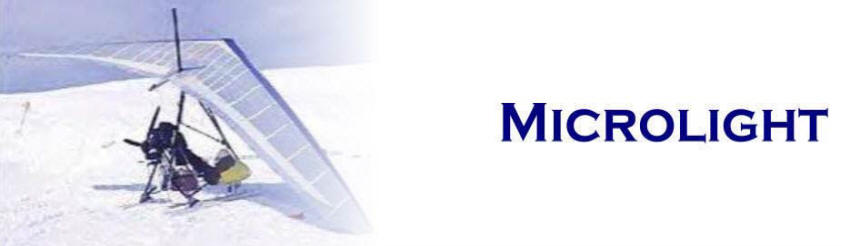
A Microlight is a simple, light-weight aeroplane which can carry a maximum of two people, take off and land in a very short space (usually less than 100m), is cheap to maintain and operate, and, most important of all, enormous fun to fly.
| There are several basic types: |
- Trikes - controlled by 'weight shift'
- Three axis - controls akin to conventional aircraft.
- Powered parachutes - have wheels or are foot launched.
Powered paragliders are a relatively new branch of the sport.
Each type has its own particular merits. Trikes, where the pilot and passenger are exposed to the wind (and rain!) like a motorbike, are often considered to be more 'fun' and are quickly and easily rigged and derigged. By contrast, though, three axis types are generally more complicated, are physically more effortless to fly and, being mostly enclosed, more comfortable in flight. Powered parachutes tend to be limited to favourable weather conditions but are extremely easy to fly and often very compact.
In spite of their low weight and cost, microlights are extremely capable aircraft. As well as being excellent for local flying, in competition even standard machines frequently fly 1,000km a day, stay aloft for 8 hours without refueling and land in a 50m strip.
MICROLIGHTING LINKS
|
|
|
|
||||||||


